Jean-Marc Chomaz | Nicolas Reeves
Lorem ipsum dolor sit amet, consectetur adipiscing elit. Aliquam tincidunt lorem enim, eget fringilla turpis congue vitae. Phasellus aliquam nisi ut lorem
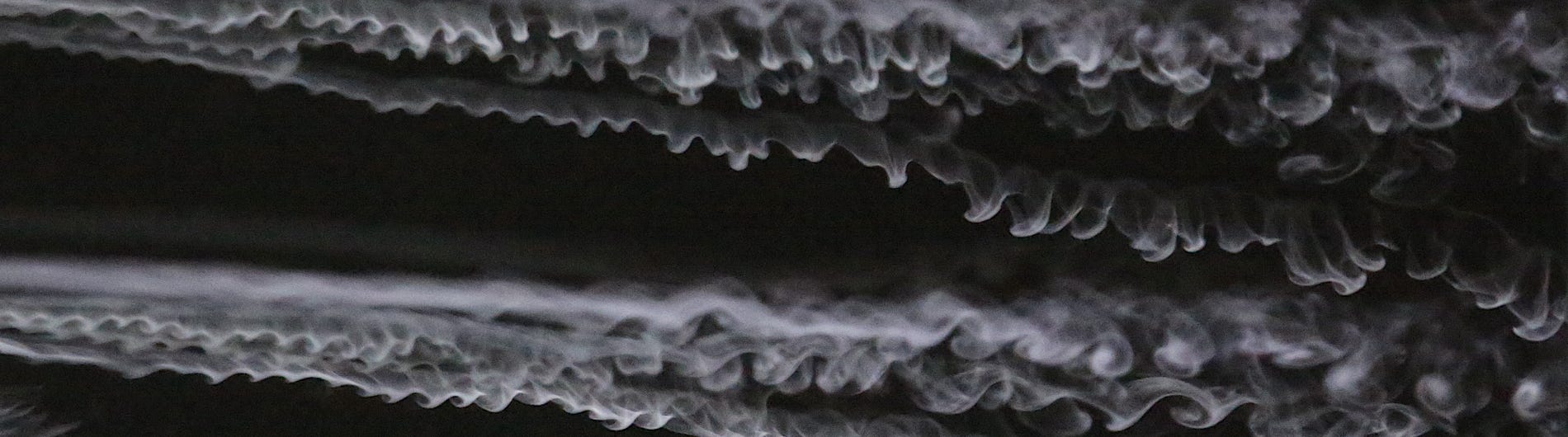
“Et mainte page blanche…” is a research-creation project at the intersection of arts and sciences. It was born from the collaboration between Jean-Marc Chomaz, artist and physicist at the hydrodynamics laboratory of the École Polytechnique, and Nicolas Reeves, creator-researcher at the design school of the University of Quebec in Montreal. In recent years, the complementarity of their interests and expertise has led them to engage in an in-depth exploration of the artistic potential of mists, fogs and hazes - the very substances the clouds are made of. Their common research leads them to create installations where mist is not considered a material to sculpt but as an autonomous element with its own personality, it specific behaviour, with which they try to establish a dialogue and to listen to the stories it has to tell.
More fundamentally, the installation questions the passage of time and the transformations of memory. It implements a calligraphy of mist that indefinitely folds and unfolds, carried by its own dynamics and by that, invisible, of the whirlwinds that the voice of poets has printed in the atmosphere. It faces us with the questions of memory and ephemerality, and on the immanent beauty that these questions induce in each and every components of our lives. We know that soap bubbles are ephemeral; this is one of the reasons why they fascinate us. Less often do we realize that the same is true of everything that surrounds us, at considerably different time scales.
All landscapes, all the places that are familiar to us, will sooner or later be eroded, buried, swallowed up by a subduction fault. They will return to the magma before erupting in the form of a volcanic eruption, or in the slow flow of lava at the bottom of a divergent fault. In five billion years, our planet will be vaporized by the final conflagration of the Sun. It will join nebulae from which other stars, other planets, other worlds will be born. Everything that exists around us ends up disappearing under processes of decomposition, erosion, fusion, which annihilate all forms of organization and return matter to its most elementary components, to then propose it to new forms, new geological structures, new living beings.
«Et Mainte Page Blanche…” speaks both of this evanescence of reality and of the memory of what once was. A handful of sand picked up in the desert carries with it the memory of buried cities, of vanished treasures, of caravans decimated by thirst, of animals long extinct. The ashes and particles transported by the smoke of great fires tell the story of devastated landscapes whose memory will spread over vast and distant territories to fertilize the trees, the rocks, the rivers. Within the enclosure of Mainte Page Blanche, the oscillation of sound waves, the voices of poets, modulate the mist in an impalpable memory which, carried by the slightest rustlings and wrinkles of the air, ramifies into myriads of microscopic whirlwinds, sources of future tremors and waves.
« Et Mainte Page Blanche…” speaks both of this evanescence of reality and of the memory of what once was. A handful of sand picked up in the desert carries with it the memory of buried cities, of vanished treasures, of caravans decimated by thirst, of animals long extinct. The ashes and particles transported by the smoke of great fires tell the story of devastated landscapes whose memory will spread over vast and distant territories to fertilize the trees, the rocks, the rivers. Within the enclosure of Mainte Page Blanche, the oscillation of sound waves, the voices of poets, modulate the mist in an impalpable memory which, carried by the slightest rustlings and wrinkles of the air, ramifies into myriads of microscopic whirlwinds, sources of future tremors and waves.
The cosmos, the geology of our planet, tell us similar stories of perpetual transformations which keep track of all the stages of their genesis. The same is true for life: natural selection, driving evolution, is governed by two principles: mutation and transmission to future generations. It thus a form of writing that invents Time and immediately tries to escape it. The discovery of DNA, chromosomes and genes revealed its inscription in the matter. But epigenetics has shown that each of these codings keeps track of several narratives which will express or not depending on the environment.
None of these stories, these prints, these trajectories, is isolated. All matter is memory. Though amorphous, the clay does carry the physicochemical traces of its history, from the Time when the cosmos was not yet transparent to the erosion of rocks under the combined action of air, water and life. Even before man traces cuneiform inscriptions to challenge the passage of time, clay is a writing.
Though deterministic, all these processes imply infinite bifurcations, amplifications of infinitesimal accidents, repentances, multiple foldings, through which they become chaotic. Far from producing a uniform disorder, far from leading to an aesthetics of oblivion, they give a form to the world, they imprint textures to spacetime, they become a palimpsest of the symmetries broken by the dynamics of the natural forces. They keep forever the memory of their past, but this past is quickly blurred in the entangled folding of their temporality.
Et mainte page blanche entre ses mains froissée aims to give a glimpse of this memory. Like a writing on a paper crumpled by the hand of a little girl, the gathers and the folds of time generate complex forms that become convolutions, veils, arabesques. They state in a fluid melancolia the impossibility, intrinsic to the deterministic chaos, to return to the origins of what is now. This melencholy, conveyed by the poem of Victor Hugo to whom the installation owes its title, could also have become the title of the piece since it expresses the multiplicity of presents that irreversibility would have made possible.
The elder daughter of chaos, poetry is a series of meanders and bifurcations between the meanings produced by the space between words. There lies the origin of the infinity of the worlds built by the poem, a gesture of the memory from which are born other universes, other realities freed from the narration which could have frozen it forever into a definitive meaning.